


Zambian coffee origin
Zambia’s coffee map is short: one main region in the north, a handful of estates further south, and new planting in the far north-west. Here is where each sits and what shapes the coffee grown there.
Why does altitude matter for Zambian Arabica?
Zambia is a high country. Most of it sits at roughly 1,000 metres or higher, and Zambia grows only Arabica, the species the law allows (Perfect Daily Grind). Coffee areas are higher still: both Perfect Daily Grind and a Starbucks origin sheet give 1,300 to 1,600 metres.
Algrano, which sells Zambian lots to roasters, says most Zambian coffee grows above 1,200 metres, with the best lots well past 1,500. That is the clearest quality marker the sources share, and it makes altitude one of the first things to ask about any Zambian lot.
Northern Province and the Muchinga escarpment
Northern Province is the heart of Zambian coffee. Perfect Daily Grind reports that most of the country’s coffee comes from there, and Algrano describes production spread across a handful of districts along the Muchinga escarpment. Coffee from the north travels to the coast through Dar es Salaam in Tanzania.
Kasama
Kasama is where commercial Zambian coffee began. Fresh Cup dates the industry’s first success to the Ngoli Coffee Scheme, established in Kasama in 1967 as a smallholder settlement. Today the district holds part of the largest estate group in the country: five estates run by NCCL in Kasama, Mbala and Mungwi districts, covering 7,200 hectares with about 2,171 hectares under coffee, plus an outgrower scheme of over 3,000 small-scale farmers (TradeMark Africa, 2022).
Mbala, Nakonde and Isoka
Algrano names Kasama, Mbala, Nakonde and Isoka among the main producing areas, all in Zambia’s north-east. Our history of Zambia’s coffee industry explains how these estates rose, closed and changed hands.
Central and southern estates: Lusaka, Serenje and Mazabuka
Away from the north, coffee is an estate crop. Perfect Daily Grind lists estates in Mazabuka, Lusaka, Serenje and Kasama, and notes that some coffee grows around Lusaka. Algrano describes a handful of estates operating further south, near Serenje and Lusaka. Southern coffee is shipped through South Africa or Namibia rather than Dar es Salaam.
North Western Province: Mwinilunga
None of the sources above includes North Western Province on Zambia’s coffee map. Mwinilunga is a town in the extreme north-western corner of the country, close to the borders with Angola and the Democratic Republic of the Congo. It sits at an average of about 1,391 metres and is described as one of the wettest places in Zambia (Wikipedia).
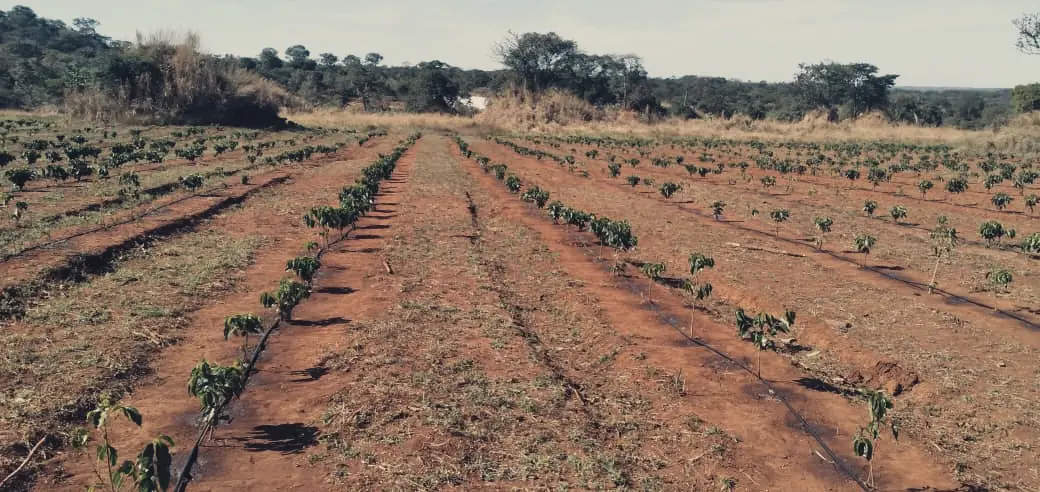
The town’s altitude falls inside the band the northern districts work in. This is where Lunga Coffee grows Arabica: an 82-hectare estate with 20 hectares planted, drip irrigation, an earth dam, access to the Kanyikomboshi River and primary wet-processing equipment (our story). We have written a full guide to Mwinilunga coffee. If you want to discuss lots from this new part of the map, talk to us about green coffee supply.
Soils, rain and the dry-season harvest
Start with the ground. Algrano describes Zambian coffee growing on older granite and gneiss soils instead of volcanic ones.
Timing matters as much as soil. The harvest runs from May to August according to Perfect Daily Grind, or to September according to Algrano, squarely inside the long dry season. Algrano notes that irrigation can play an important role in keeping production consistent.
Mwinilunga shows the same pattern from a wetter starting point. The town receives roughly 1,400 mm of rain a year, mostly from October to May (the 1991 to 2020 climate table gives an average of about 1,316 mm). The months between are much drier, which is why reliable irrigation is one of our immediate priorities on the estate. For how growers manage water, nurseries and planting, read coffee farming in Zambia; for what these regions produce in flavour and variety, see Zambian Arabica. The wider picture is in our complete guide to Zambian coffee.
Questions about Zambia’s coffee regions
Which province grows the most coffee in Zambia?
Northern Province. Perfect Daily Grind reports that most Zambian coffee comes from there, grown at 1,300 to 1,600 metres.
What altitude is Zambian coffee grown at?
Mostly between about 1,200 and 1,600 metres. Algrano says most Zambian coffee grows above 1,200 metres, with the best lots well past 1,500.
Is coffee grown near Lusaka?
Yes. Estates operate around Lusaka, and further afield at Serenje and Mazabuka.
Is coffee grown in North Western Province?
Yes. Lunga Coffee grows Arabica at Mwinilunga, with 20 hectares planted on an 82-hectare estate.
What soils do Zambian coffee farms have?
Algrano describes Zambian coffee as growing on older granite and gneiss soils rather than volcanic ones.